Game Technology in Business Growth, Innovation & Future Opportunities
15
Jan, 2026

Game Technology in Business: Growth, Innovation & Future Opportunities

In recent years, the world of business has been developing faster than ever, and one of the most remarkable forces behind this change is game technology. We know that what once started as pure entertainment has now become a serious business tool, driving innovation, engagement, and profitability across industries. Now, companies are squeezing gamification into business. Virtual reality (VR), augmented reality (AR), and artificial intelligence (AI) are not only intended to make consumers happy but also to empower employees and streamline operations.

As Forbes explains, the future of gaming is closely tied to the future of technology. And the businesses that identify this potential are already using game-based models to keep competitive in bustling markets.

How Game Technology is Reshaping Modern Business Strategies

Traditionally, business strategies focused on cost, marketing, and customer service. Today, companies in the digital economy stand out by using gaming technology. Many are adding features like levels, rewards, points, and challenges to motivate employees, connect with customers, and streamline supply chains. Some are also using VR simulations, AR shopping, and AI-powered analytics to go further than simple gamification.
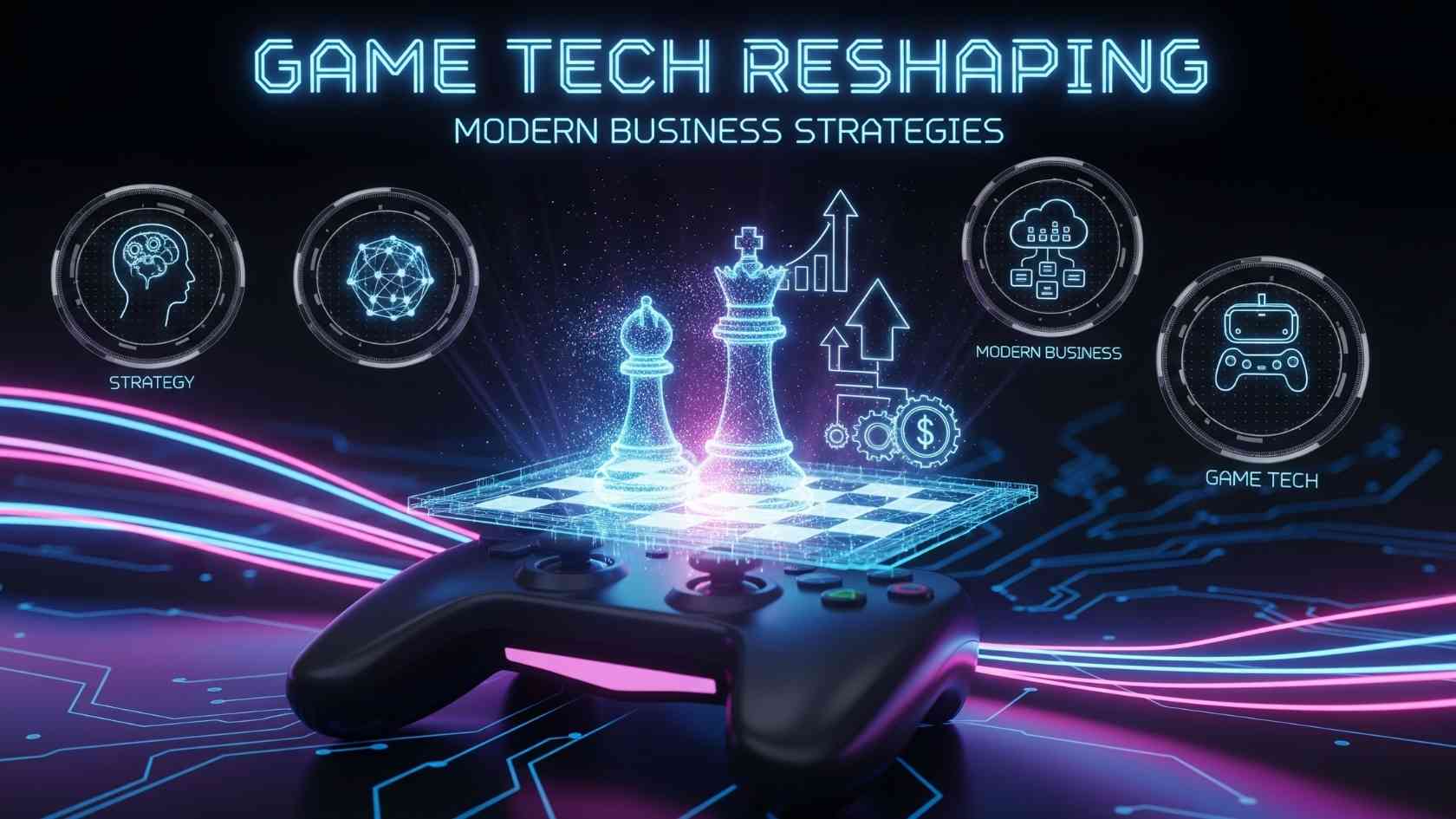
How Game Technology is Reshaping Modern Business Strategies

According to TechRadar, game technology is no longer niche—it’s reshaping the core of business operations. And across healthcare and retail, almost every sector is finding innovative applications for these instruments.

Benefits of Gamification in Business

Today, gamification has emerged as one of the most effective business strategies for innovation and growth. It is not just adding games to work—it’s all about applying game design thinking to unlock business problems.
Major advantages are:

1. Higher Employee Motivation:

Employees are busier when their progress is tracked through leaderboards, badges, and challenges. It encourages them to perform better and gives them that sense of fit competition.

2. Improved Customer Devotion:

Certain gamified loyalty programs, such as reward points and achievement levels, stimulate repeat purchases and brand stickiness.

3. Better Training & Skills Upgrade

Gamified training experiments make learning more engaging, enhancing loyalty and reducing onboarding time for rookies.

4. Innovation & Problem-Solving:

By requesting innovative game-related tasks, companies encourage innovation and inspire teams to think beyond the box.
According to Entrepreneur, numerous companies have achieved paradigm shifts by incorporating gaming structures into product development and customer participation models.

Applications of Game Technology in Different Industries
Applications of Game Technology in Different Industries

Over time, the influence of game technology has grown among gaming firms. Some of the strongest industries utilizing its potential are mentioned below:

Governance

To manage pain, do physical therapy, and even do mental therapy, virtual reality is employed. And also simulations for surgeons in medical school.

Education

Gamification is so great that gamified learning platforms are gamifying the classroom. And the student gains more knowledge when learning is like a game.

Retail & E-commerce

AR-enabled applications enable customers to “try before they buy,” such as trying out furniture in their living room or virtually trying on makeup.

Marketing & Customer Experience:

Corporations use gamified apps, contests, and interactive ad campaigns to attract and retain customers while harvesting valuable user data.
These demonstrate that game technology is an entrepreneurial endeavor that can be customized for multiple industries.

Future of Game Technology in Business

The future of game technology involves enhancing business experiences through greater immersion, personalization, and intelligence. There are going to be multiple trends that remain dominant in the years ahead:
  • AR & VR in Day-to-Day Business: There would be use of AR for remote assistance, product development, and employee training.
  • AI-Based Personalization: Artificial Intelligence will develop customized customer journeys based on behaviour and preferences.
  • Virtual Workplaces: Companies would use metaverse-like virtual offices for conferencing.
  • Data-Based Decisions: Gaming technology will provide behaviour data, allowing firms to forecast trends and make better decisions.
As TechRadar notes, companies that move into these technologies first won’t just remain competitive but will dominate the future of work.

Businessmen should avoid the following mistakes:

Game tech offers unique visions for small-business growth and entrepreneurial innovation. Visionary entrepreneurs may:
  • Design gamified learning websites for business and school training.
  • Minimize customer skepticism with VR/AR-driven product demonstrations.
  • Release gamified smartphone applications that call for repeated use and loyalty.
  • Use AI-driven simulations in predicting business risks and opportunities.
  • Produce engaging marketing campaigns that have more engagement than static commercials.
By exploiting these opportunities, companies not only expand but also stand out from the competition.

Conclusion

Business incorporation of game tech is not far off—the future is now. From gamification to full-blown VR immersion, businesses are revolutionizing their operations, training, and customer interfaces.

Start-ups and businesses that adopt this trend are reaping the reward: increased engagement, productivity, and brand attachment. With continued advancements in technology, the future of game tech will dictate the future of business in general.

Business is now ready to move. Through gamified training, AR-enabled shopping, or AI-powered personalization, possibilities are limitless. Here is not the question: whether game technology is going to transform business, but when and how fast your company is going to evolve towards it.

Frequently Asked Questions (FAQs)

Q. Define game technology in business.

Business game technology is the application of gaming principles, technologies, and innovations, such as gamification, virtual reality (VR), augmented reality (AR), and artificial intelligence (AI), to enhance worker engagement, customer stickiness, and process effectiveness in companies.

Q. Why does gamification make companies grow faster?
A: Gamification increases motivation, productivity, and learning with rewards, leaderboards, and challenges. It enhances customer loyalty programs, worker training, and promotional campaigns for companies.
Q. Which sectors does game technology benefit the most?
A: Industries such as healthcare, education, retail, marketing, and e-commerce belong to the leading adopters’ category. They employ VR for training, AR for products, and gamified apps for customers.
Q. Where is the game technology of business heading in the future?
A: Top trends are AR/VR in operations, personalization through AI, metaverse-like virtual offices, and decision-making through gaming analytics and data-driven decisions.
Q. Which errors should a company refrain from committing when applying gamification?
A: Companies should refrain from complicating game mechanics, neglecting the use of a reward-entered approach only, failing to quantify outcomes, and refusing to adapt.