Startup Booted Fundraising Strategy: A Smarter Way to Grow in 2026
Startups are difficult to build, and raising money too soon may make the process even more challenging. This is why a startup’s bootstrapping fundraising strategy is a wiser option, preferred by many founders, as it emphasises initial revenue, lean expansion, and improved management.
Founders rely on customer revenue and discipline to create traction before turning to investors from day one. This model is gaining popularity in 2026, as funding becomes more selective and sustainable growth matters more than hype.
What Is a Startup-Booted Fundraising Strategy?
The startup-bootstrapped fundraising strategy is a growth approach that involves starting lean, generating revenue early, and using that cash to scale before raising external capital.
In simple words, it is a combination of bootstrapping and smart fundraising. The founder is not in a hurry to raise investors. Rather, they validate the idea, release a minimum viable product, acquire paying clients, and do not consider external funding until it becomes necessary to accelerate the business’s growth.
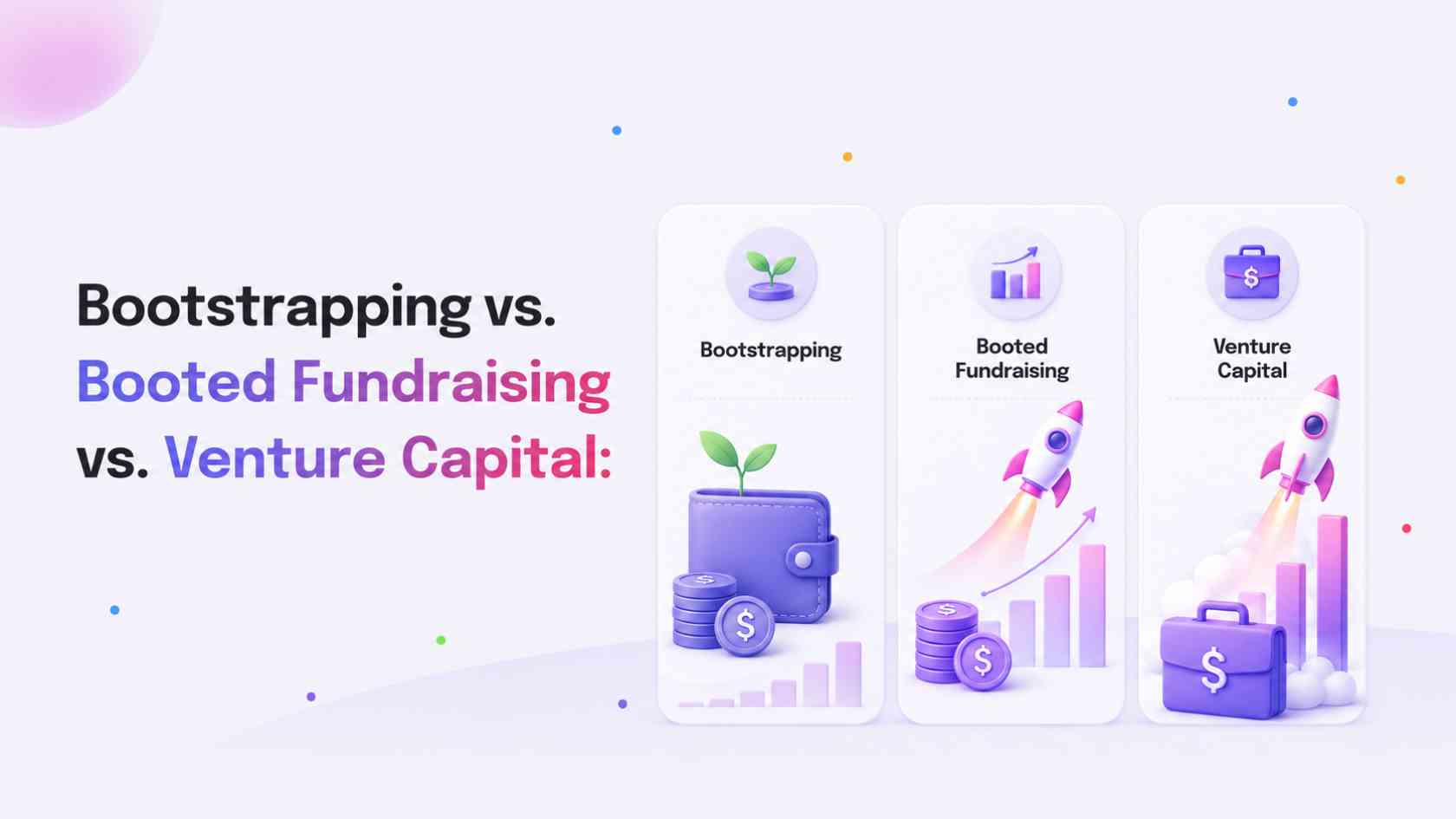
Bootstrapping vs. Booted Fundraising vs. Venture Capital:
What is Bootstrapping
‘Bootstrapping’ refers to using one’s own savings or company income. It offers optimal control for founders but tends to grow more slowly.
Booted Fundraising
Booted fundraising is a mid-range model. The startup expands initially through its own revenue and later, as needed, through external funding. This enables founders to maintain more ownership while still leaving room to scale.
Venture Capital
‘Venture capital’ refers to the process of getting money from investors in the form of equity. It can accelerate growth but also entails greater dilution, pressure, and less founder control.
This model is attractive to founders who want to retain control while still having the opportunity to raise capital in the future from a stronger position.
Why Founders Are Choosing Booted Fundraising in 2026.
Funding is preferred in 2026. Investors want movement, sales, and visibility to profit. Meanwhile, founders do not want to dilute early and retain additional control. Booted fundraising helps them to grow first, then raise funds in a much better position.
It is also gaining popularity because startups now launch leaner, test faster, and build at lower costs.
Revenue-First Growth Model
Revenue-first growth is at the center of a startup booted fundraising strategy. The startup does not rely on early investors, but instead on customer funding.
That means revenue becomes the fuel for building, developing, and scaling the business.
This model challenges founders to focus on the basics:
- solving a real problem
- getting paying customers
- improving retention
- growing with discipline
Revenue-first growth creates a strong business foundation. It helps the startup stay on track with market needs, rather than what may please the investors.
It also helps founders to remain lean, secure ownership, and scale more sustainably.
Also Read: Top Business Strategies for Startup Success: Tips for Entrepreneurs
Common Bootstrapped Funding Models
A startup’s fundraising strategy can not be done in one way. Founders select a model according to their budget, risk, and business type.
-
Personal savings
Others can start using their personal savings to meet initial expenses such as product development, equipment, or business. This gives them complete control and the ability to move without investor pressure.
-
Revenue-led growth
In this strategy, a startup expands through customer charges. Founders focus on early revenue, then use the money to enhance the product, and then grow slowly.
-
Side-hustle model
Others continue to work or have a source of income and build their startup. This alleviates financial strain and allows them to test the business at a lower risk.
-
Lean model
The lean approach is about spending less and testing fast. Founders begin with little, get feedback, and only expand when there is evidence of demand.
How the Strategy Works Step by Step
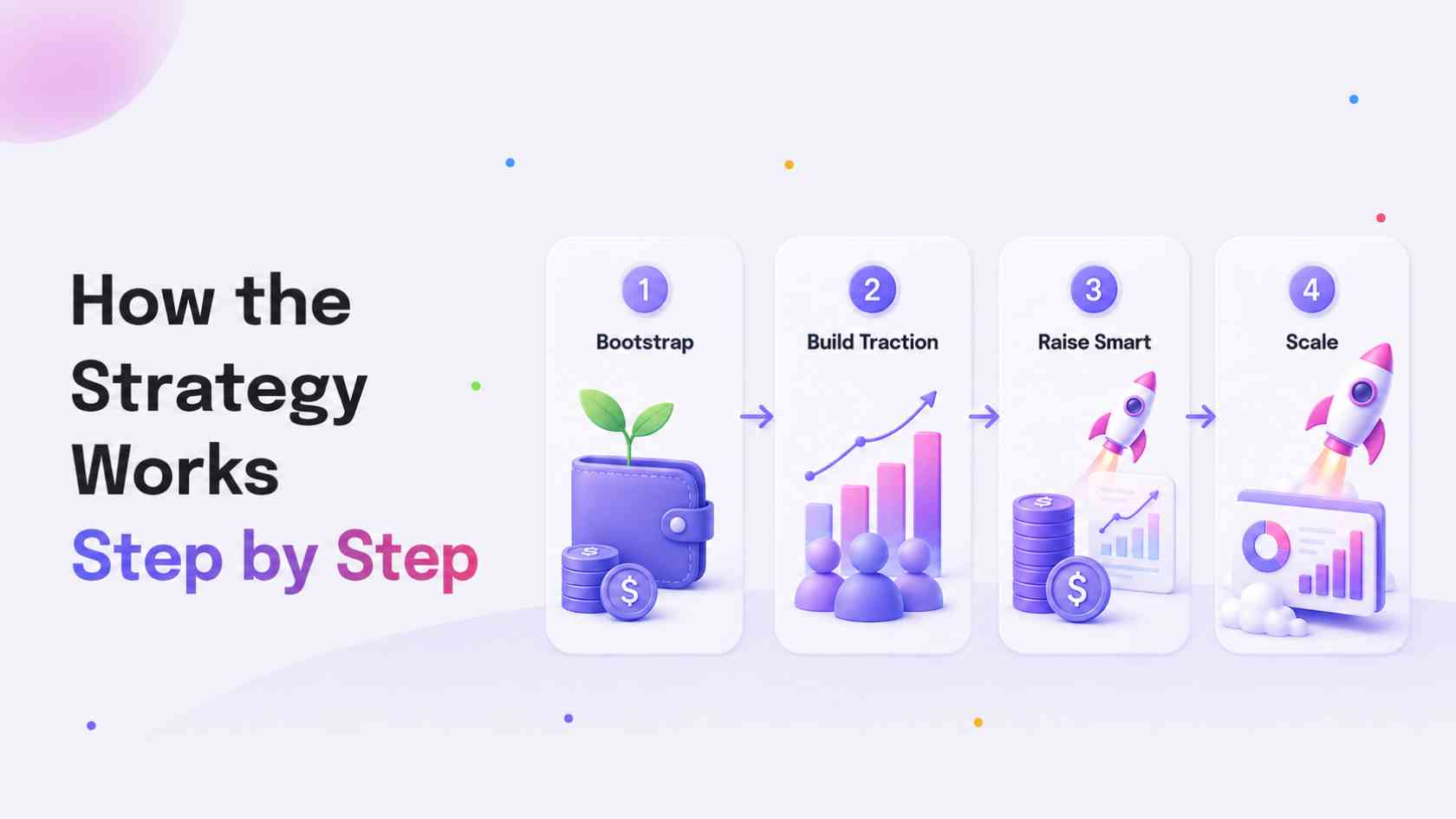
A booted fundraising strategy usually follows a step-by-step, practical approach.
Validate a Real Problem
The startup must start with a market need. Founders need to engage potential customers, understand pain points, and ensure they are willing to pay for a solution.
Make a Revenue-Generating MVP
Rather than designing an ideal product, develop a version that addresses the basic issue. The goal is not complexity. The idea is to reach the market quickly.
Get Early Paying Customers
This is the most significant phase. Customers are not only users in a booted model. They are the initial source of startup funding.
Reinvest Revenue
The business should reinvest any initial gains. That can be product enhancement, promotion, recruitment, or improved systems.
Scale Sustainably
After establishing a stable market demand, the founder is ready to expand through repeatable sales and financial discipline.
Add Strategic Funding
External funding is not compulsory at this level. When the startup grows, it does so with greater bargaining power and increased evidence of success.
Advantages of Booted Fundraising
Booted fundraising offers more control to founders in the initial stages. It enables them to develop ownership, financial discipline, and a closer relation to actual customer demand.
- Founders typically retain greater control and make decisions without such outside pressure.
- With constrained resources & stronger discipline, a smarter expenditure and smarter priorities can be cultivated.
- Revenue is significant at low stages, so the company remains centered on actual demand.
- Revenue-supported growth usually makes the business more sustainable.
Risks of Bootstrapping a Startup
This solution has trade-offs as well. Growth may be slower, and the pressure on founders may be significantly greater.
- Without substantial capital, the growth process takes longer.
- Multitasking may cause stress, pressure, and burnout to the founder.
- Slow growth may complicate the ability to win fast-moving markets.
- VC-backed startups can spend more on growth than the booted businesses.
Booted Fundraising vs Venture Capital
The decision between Booted fundraising and venture capital depends on your business model. The most appropriate alternative suits your startup’s objectives, growth, and market.
| Factors | Booted Fundraising | Venture Capital |
|---|---|---|
| Ownership | Founders typically retain greater equity and control | Founder ownership often declines with time |
| Decision-making | More freedom and less outside pressure | More influence of investors in major decisions |
| Growth rate | Generally slower but more regulated | High growth in the presence of capital |
| Pressure | Pressure is exerted by customers, revenue, and cash flow | Pressure is exerted by investors and growth targets |
| Profitability | Focus often starts earlier | Often delayed for scale. |
| Best fit | Best for software, Saas and lean startups | Best for Bio tech, Deep tech, and capital-heavy areas |
Also Read: Startup Bootstrapped Financial Modeling: A Complete Guide to Sustainable Growth
Common Fundraising Mistakes and When Bootstrapping Fails
Bootstrapping is effective, but it fails when there is a lack of product-market fit, high startup costs, or poor cash flow management. When the demand is low, revenue cannot sustain growth.
Other common mistakes made by founders include underestimating costs, avoiding smart investments, inadequate financial planning, and premature raising.
Financial Planning Bootstrapped Startups.
Bootstrapped startups need financial planning since each dollar counts.
Cash flow management
Monitor receipts and payments every month. Pay attention to accelerated payments, lower overheads, and predictable costs.
Budgeting strategies
Divide expenditure into necessities, development, and non-necessary expenses. Focus on what enhances revenue, retention, and delivery.
Emergency funds
Target 3 to 6 months of operating expenses. This protects the business during low months or unforeseen expenses.
Bootstrapped Startup Marketing Strategies.
Bootstrapped startups require low-cost marketing channels to grow with time.
SEO
SEO helps in generating long-term organic traffic. Target buyer intent, issue, niche, keywords.
Content marketing
Write helpful blogs, guides, case studies, and frequently asked questions that respond to customer queries and create trust.
Social media
Use one or two of the platforms where your audience is active. Post information, success stories, and content.
Word-of-mouth
Customer satisfaction is a good channel of marketing. Promote word-of-mouth.
Key Metrics Every Founder Must Track
MRR:
Measures the amount of predictable revenue from active customers monthly. It is among the best signals of momentum, stability, and growth quality in a recurring-revenue business.
CAC:
This is calculated as total sales and marketing expenses / the number of new customers. This indicates the business efficiency in turning investment into customer growth.
LTV:
LTV = average revenue/ customer x life span of customer. It helps founders understand the long-term worth of customer relationships and the commercial viability of acquisition costs.
Burn Rate:
monthly expense /monthly revenue. This shows the rate at which the company is burning cash and maintaining the current expenditure level.
Runway:
Cash in bank/monthly net burn. Runway also indicates how much time the business has before additional revenue, cost reduction, or raising funds.
A strong operating benchmark is usually an LTV: CAC ratio of 3:1 or higher, and 6 to 12 months of runway, which gives founders enough room to make strategic decisions without short-term pressure.
Bootstrapped Fundraising (2026+) Future Trends

Bootstrapped startups are increasingly viable as technology lowers the cost of creating and expanding a business. Lean growth is becoming more feasible as AI assists founders to operate, market, and develop products with fewer resources. Meanwhile, the rise of solo founders indicates that great businesses can now be established without massive teams and initial capital. The market is also shifting towards efficiency, profitability, and sustainable growth, making bootstrapped startups more relevant than ever.
Also Read: 10 Low-Cost Startup Ideas You Can Launch in 2026
Final Thoughts
Bootstrapped fundraising offers a business to grow in 2026 with high stability. Rather than chasing external capital, it enables businesses to gain initial momentum, revenue, and establish a strong base before raising capital. This method will not only protect founder control and ownership but also promote financial discipline, smarter decisions, and long-term stability. Although it does not apply to all businesses, especially those in capital-heavy industries, it remains a powerful strategy for startups that want to grow with clarity, efficiency, and stronger fundamentals.
FAQS:
1. What is booted fundraising?
It is the process of growing a startup using self-funding, income, or non-dilutive capital rather than depending heavily on investors.
2. Is VC better than bootstrapping?
It depends on the business. Bootstrapping provides greater levels of control, and VC assists businesses in growing more quickly.
3. What is the minimum amount of capital required?
That depends on the industry, but most digital or service startups can launch with small capital.
4. What is the largest hazard of bootstrapping?
Running out of cash when the business has not stabilized its revenue.
5. When should a founder seek outside Funding?
A founder should raise when the startup already has traction, and the funding is used to accelerate successful growth rather than rescuing a shaky business.