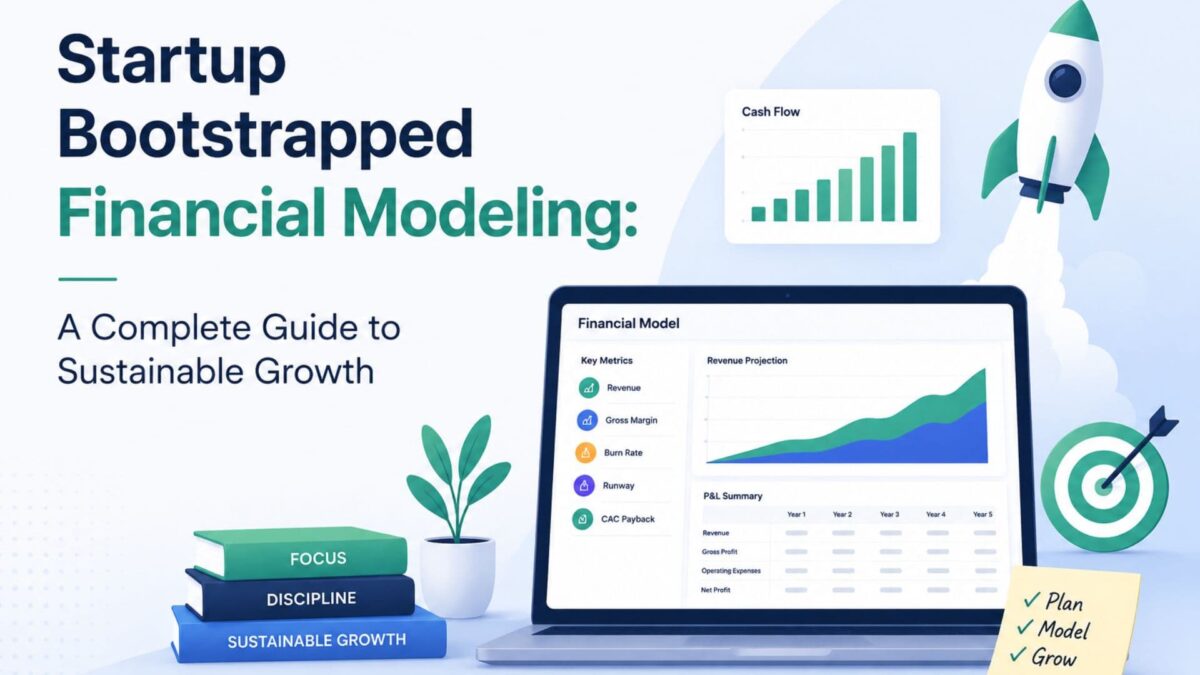
Startup Bootstrapped Financial Modeling: A Complete Guide to Sustainable Growth
Bootstrapped startups are built differently. Founders will have to rely on their savings, initial income, and a professional implementation of their business growth without external investors. Financial modeling is not only a tool of planning in this environment, but the foundation of survival and long-term success. Revenue-first ensures that all decisions, including hiring or marketing, are based on real financial potential, as opposed to hypothetical funds.
Startup bootstrapped financial modeling focuses on driving long-term growth by forecasting, managing costs, and reinvesting. This paper will discuss how founders can build viable financial models, learn the important metrics, and make smarter decisions without giving up ownership and control of their venture.
What Is Startup Booted Financial Modeling?
Startup booted financial modeling is planning, predicting, and operating expenses of a startup without using venture capital or external financing. This model prioritizes profitability, efficiency, and consistent growth over rapid growth driven by investor capital.
In contrast to venture-driven financial models, which focus on rapid growth and market penetration, bootstrapped financial models operate with reality. They are built around actual revenue, controlled spending, and sustainable operations.
Its core pillars are revenue-based growth, lean operations, founder retention, and creating independent business control. All financial choices are based on long-term sustainability instead of short-term valuation.
Why Financial Modeling Matters for Bootstrapped Startups
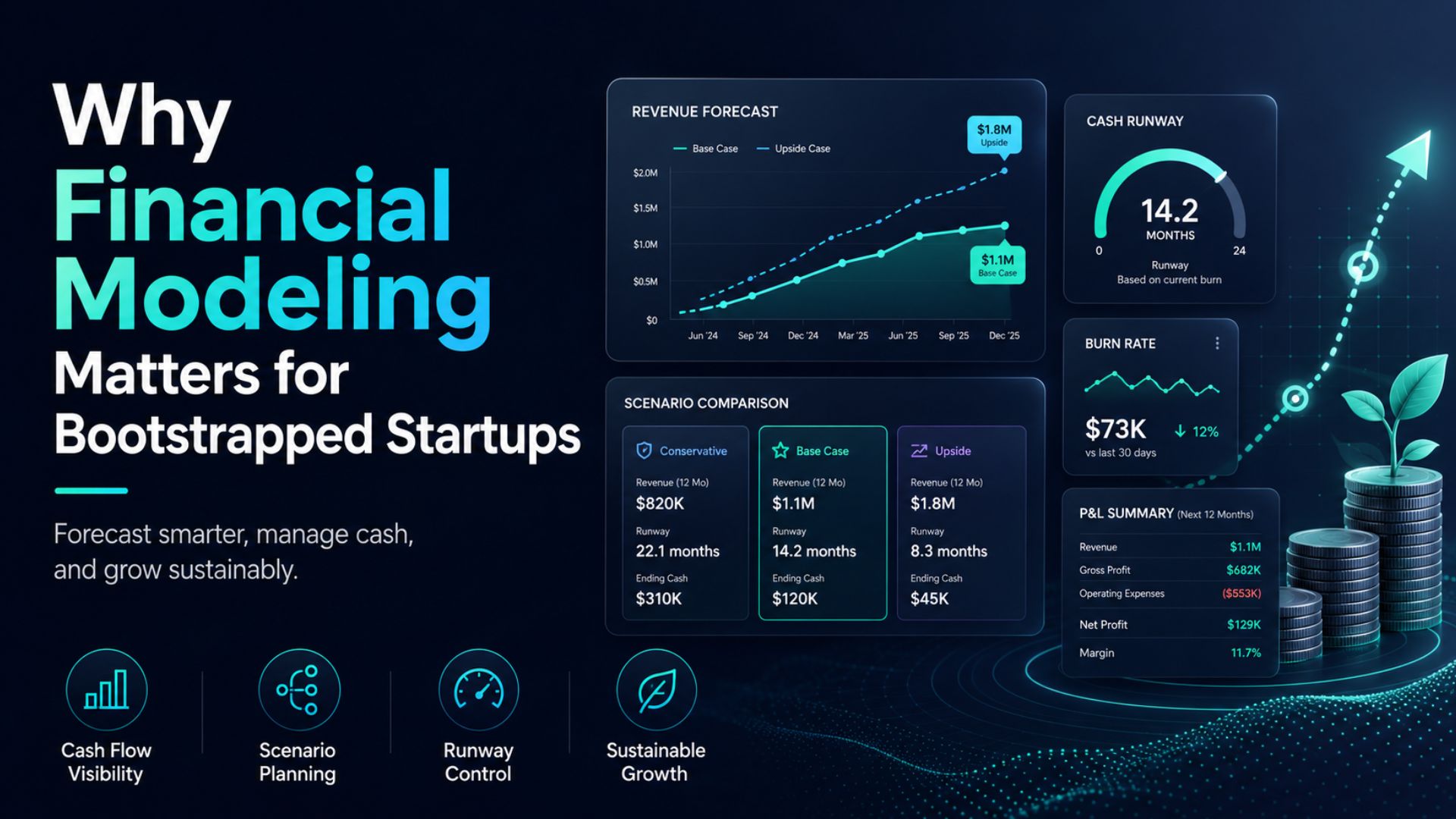
Financial modeling provides founders with a precise view of their business health. It aids in tracking income, costs, and cash flow so the company operates within its limits and prevents financial surprises. It also facilitates smarter decisions. Before investing in hiring, marketing, or product development, founders evaluate costs and expected returns, reducing unnecessary risks.
Through good financial management, startups will avoid external capital and maintain full ownership of their business.
Above all, financial modeling facilitates sustainable growth. Founders will grow their business to match their revenue and operational capabilities rather than expanding too rapidly.
Bootstrapped Startup Financial Statements
Profit and Loss Statement (P&L)
The P&L indicates income, cost, and profit. It assists founders in identifying profitable locations and managing unnecessary expenditures.
Cash Flow Statement
This follows cash receipts and payments. It ensures that the business does not run out of money to run its daily operations.
Balance Sheet
The balance sheet reports the assets, liabilities, and equity. It provides an overview of the financial status and startup stability.
Startup Metrics Dashboard
A metrics dashboard monitors MRR, CAC, CLV, churn rate, and cash runway. These are indicators that measure growth and long-term sustainability.
Key Elements of a Bootstrapped Financial Model
Revenue Streams
Any source of revenue, such as subscriptions, products, or services, must be specific. The streams have to be predicted to know their effect.
Cost Structure
Costs are divided into fixed and variable. This aids in controlling the costs and scaling growth.
Operating Expenses
The operating expenses include salaries, marketing, and tools. These are to be managed to be profitable.
Capital Expenditure (CapEx)
CapEx involves long-term investments such as product development. These are costly in terms of initial expenses.
Financial Assumptions
Some of the assumptions are growth rate, pricing, and churn. Correct assumptions result in improved financial planning.
Also Read: 10 Low-Cost Startup Ideas You Can Launch in 2026
How to Build a Startup Booted Financial Model (Step-by-Step)
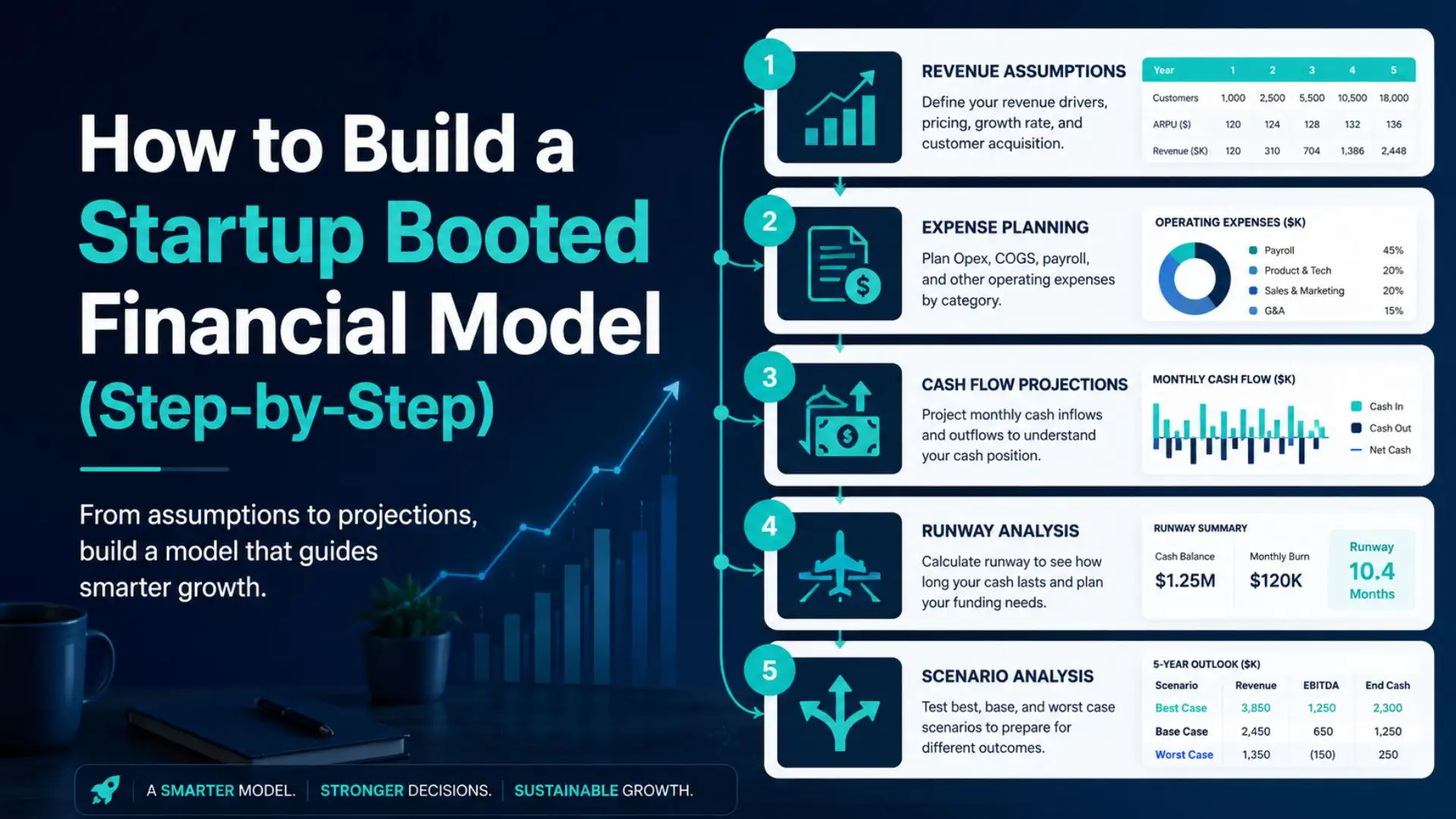
- Define how your start-up will generate profit by identifying sources of income and realistic pricing mechanisms depending on your target market.
- Predict monthly revenue by estimating customer growth, conversion rates, and average spending to generate realistic revenue projections in the long run.
- To keep your finances under control, map your cost structure by identifying all your expenses and then splitting them into fixed and variable costs.
- Prepare cash flow forecasts to monitor monthly inflows and outflows, so that the business has sufficient funds to cover its operations.
- Work out the break-even point to know at what point you will cover all expenses, and the business will be sustainable.
- Monitor key indicators such as customer acquisition cost (CAC), customer lifetime value (CLV), churn rate, and runway to track efficiency and growth potential.
- Always update the financial model by replacing assumptions with authentic performance data.
Understanding Unit Economics for Bootstrapped Startups
Unit economics show how profitable each customer is. Customer acquisition cost (CAC) is the amount of money spent to acquire a customer in marketing and sales. Customer lifetime value (CLV) estimates the total revenue given to the customer over time.
A successful business has a good balance between these measures. The best LTV: CAC ratio is 3:1, i.e., the business earns three times what it spends in acquisition. This equilibrium guarantees stable growth.
Scenario Planning in Bootstrapped Financial Modeling
Scenario planning helps founders prepare for uncertainty by making numerous financial forecasts, depending on various possibilities. At its best, revenue increases at a faster rate, expenses remain under control, leaving space to invest and grow. The practical scenario is based on constant growth with realistic assumptions and is most applicable in everyday decision-making. Conversely, the worst-case scenario assumes slower revenue or unexpected expenses, allowing businesses to survive in challenging times. By comparison of such scenarios, founders mitigate risk and make better financial decisions.
Financial Modeling at Stages of Startup Growth
Pre-Revenue Stage
At this level, the concern is on the management of development expenditure and minimum operations. Financial modeling ensures that available resources last until the product is ready to launch.
Revenue Validation Stage
Founders begin testing unit economics and tracking early customer growth. The model is more credible when actual data begins to substitute initial assumptions.
Growth Stage
The company begins to increase marketing activities and team growth. Financial modeling will keep the growth on track with real revenue and will not cause financial strain.
Scaling Stage
At this stage, business ventures into new markets and reinvests profit into growth. The financial model is more detailed yet focused on profitability and long-term stability.
Common Mistakes in Startup Booted Financial Modeling
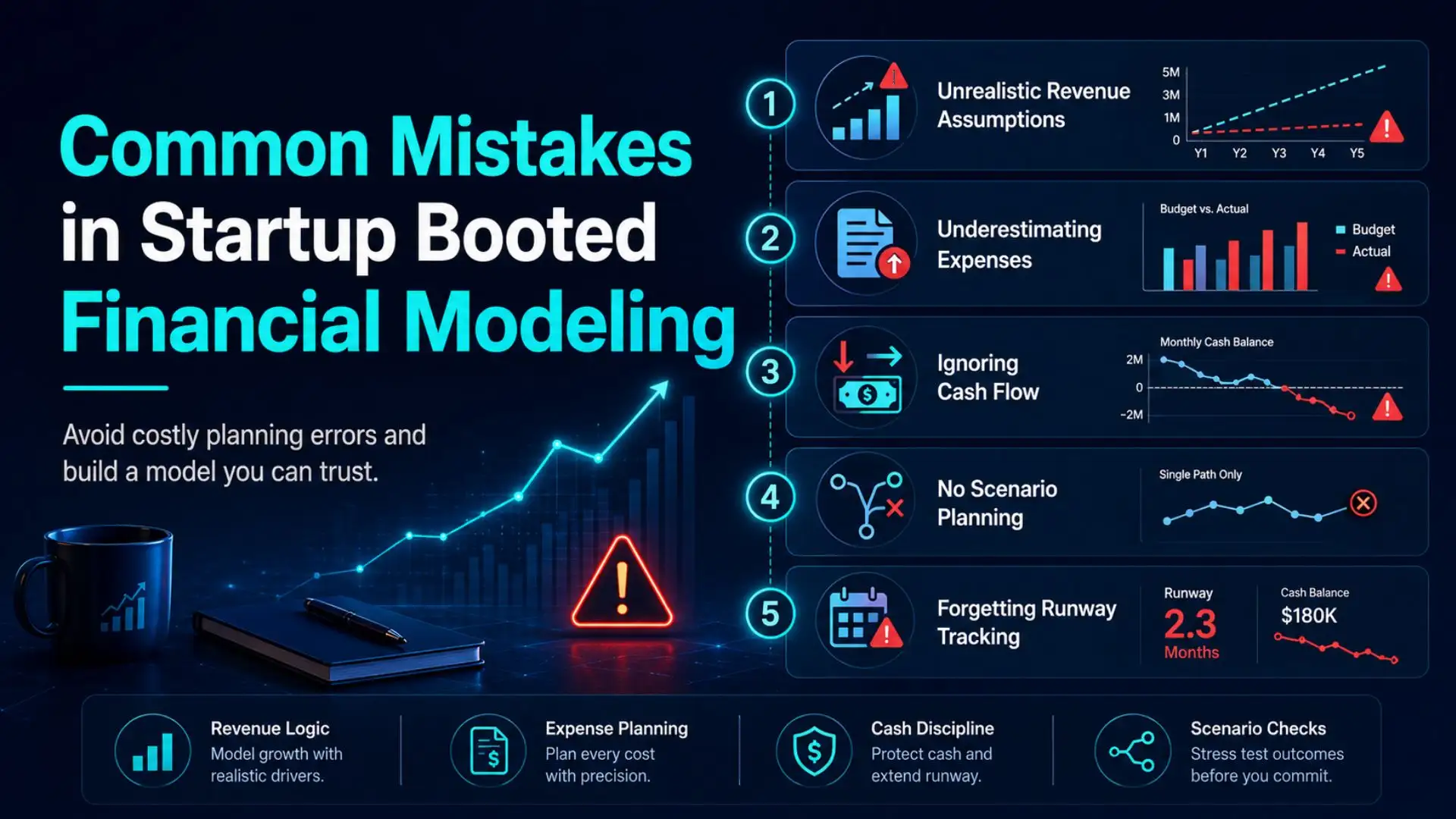
Most startups overestimate revenue, thus creating unrealistic expectations and overspending. Meanwhile, underestimating operating costs may lead to cash flow issues due to hidden expenses arising during growth.
The other critical mistake is neglecting the cash runway, because founders must always know how long the business can survive with existing cash. Other founders develop excessively complicated financial models that are hard to operate, whereas simplicity can be more informative. Finally, the model is less effective and less useful for decision-making when it is not updated.
Best Tools for Startup Financial Modeling
Spreadsheet Tools
Google Sheets and Microsoft Excel are common tools to create flexible financial models. They are fully customizable, making them good at forecasting, budgeting, and scenario planning.
Accounting Software
Software like QuickBooks and Xero helps track the actual financial information and keep proper records. This makes financial models grounded in actual performance, which enhances reliability.
SaaS Analytics Tools
Baremetrics and ChartMogul tools will give information about subscription metrics, including MRR, churn, and customer behavior. These are especially useful for SaaS startups focused on recurring revenue.
Planning & Forecasting Tools
Tools such as Airtable and Notion help in structuring financial data, assumptions, and workflows. They enhance transparency and cooperation.
How Strong Financial Modeling Attracts Investors
A well-developed financial model indicates the startup knows its numbers and runs in a disciplined way. It shows a straight line to profitability, not quick growth, and developing investor confidence.
It also shows effective resource utilization, good planning, and projections. These signals show that founders are data-driven and capable of managing capital effectively, making the business more attractive for future funding opportunities.
Future Trends in Startup Financial Modeling
- AI-powered financial modeling is developing to enhance forecasting on real-time data. Such tools help founders make better decisions faster.
- Live dashboards are becoming a necessity, allowing startups to track performance regularly and react swiftly to changes.
- Hybrid funding is also rising, where startups combine bootstrapping with selective funding at later stages to balance control and growth.
- Sustainability measures are becoming relevant, and long-term environmental and social impacts, as well as profitability, are becoming priorities of businesses.
Also Read: Startup Booted Fundraising Strategy: A Smarter Way to Grow in 2026
Conclusion
Startup booted financial modeling is not just numbers; it is a business model that helps founders build a stable, self-sustaining organization. Startups reduce risk and have complete control and ownership by pursuing revenue-first growth, disciplined spending, and precise forecasting.
An effective financial model enables wiser decisions, makes the business more efficient, and prepares it for long-term success. As markets evolve, the founders who regularly revise their financial models and adapt to real data will be better positioned to scale responsibly and seize future opportunities.
FAQs
What is startup booted financial modeling?
It is the process of developing and running a startup’s finances by using internal resources and revenue rather than outside funding.
How is it different from venture capital financial modeling?
Bootstrapped modeling is related to profitability and sustainability, whereas venture capital models tend to favor fast growth and expansion.
Which tools are best for startup financial modeling?
The most commonly used tools are spreadsheets like Excel, accounting systems like QuickBooks, and analytics applications like Baremetrics.
How often should founders revise their financial model?
The model would ideally be revised monthly or whenever major changes occur in revenue, costs, or strategy.
Will financial modeling attract investors?
Yes, a strong financial model demonstrates discipline, profitability potential, and readiness for investment, making the startup more appealing to investors.